
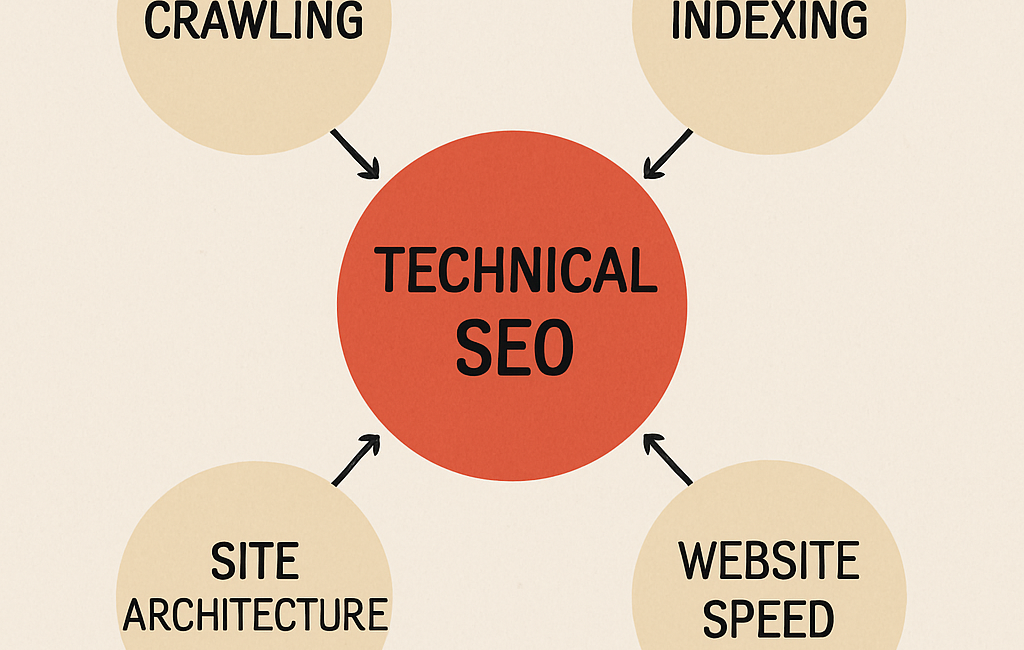
Technical SEO is one of the most important parts of a complete SEO strategy. It focuses on the behind-the-scenes systems that determine whether search engines can access, understand, and confidently rank your website.
In practice, technical SEO often shows up as performance improvements (like speeding up a website), stronger crawlability and indexing, and a more reliable user experience across devices. When these fundamentals are weak, even strong content and well-targeted pages can struggle to perform.
This article defines technical SEO and explains how it fits into the four pillars of SEO: technical SEO, on-site SEO, off-site SEO, and content marketing. If you want expert help across all four pillars without having to build an in-house team, SEO Exchange can help.
What Is Technical SEO?
Technical SEO is the practice of optimizing a website’s technical foundation so search engines can efficiently crawl, render, understand, and index its pages. It also includes performance and reliability factors that affect both search visibility and user experience.
Unlike on-site SEO (which is about what your pages say), technical SEO is about how your site behaves and how clearly it communicates with search engines at a system level.
Why Technical SEO Matters for Website SEO
Technical SEO supports nearly every outcome people want from SEO optimization: stronger rankings, more consistent indexing, and better engagement from organic traffic. When technical quality is high, search engines have fewer obstacles when evaluating your site, and users are less likely to bounce due to friction like slow load times or broken experiences.
In other words, technical SEO helps your website become easier to discover, easier to interpret, and easier to trust.

The Four Pillars of SEO (and What They Mean)
A well-rounded SEO strategy is typically built on four complementary pillars. Each pillar serves a different purpose, and the best results usually come from aligning all four.
- Technical SEO: The infrastructure and systems that enable search engines to access, understand, and index your website (including speed, crawlability, mobile readiness, and security).
- On-site SEO: The relevance and clarity of individual pages, including topics, intent alignment, internal linking, headings, and how well the page communicates what it is about.
- Off-site SEO: Signals that happen beyond your site that influence perceived authority and trust, most commonly links, brand mentions, and other external credibility indicators.
- Content marketing: The strategy and production of content assets that attract, educate, and convert your audience over time, supporting both brand growth and organic visibility.
What Technical SEO Commonly Includes
Technical SEO is broad, but most work falls into a set of recurring themes. Below are definitions of the core areas commonly associated with technical SEO (without getting into the “how”).
Crawlability
Crawlability refers to whether search engines can discover and access the URLs on your website. If important pages can’t be crawled reliably, they may never be evaluated for ranking.
Indexing
Indexing is the process of storing and organizing your pages in a search engine’s database so they can appear in search results. Indexing problems can lead to missing pages, outdated pages, or the wrong page version appearing for a query.
Site Architecture and URL Structure
Site architecture describes how your pages are organized and connected. URL structure describes how those pages are represented in web addresses. Together, they influence how easily search engines and users can navigate your site and interpret relationships between pages.
Website Speed and Performance
Website speed and overall performance reflect how quickly and smoothly a site loads and responds for users. Performance is closely tied to user satisfaction and is frequently associated with stronger SEO outcomes because it reduces friction for both users and search engines.
Mobile Optimization
Mobile optimization refers to how well your site functions on mobile devices, including layout stability, usability, and performance. Because many searches happen on phones, mobile readiness is a foundational part of modern website SEO.
Security (HTTPS) and Trust Signals
HTTPS indicates that a site uses encryption to protect data in transit. Security is a baseline expectation for users, and it contributes to a more trustworthy browsing experience, which can support SEO performance.
XML Sitemaps and Robots.txt
XML sitemaps are files that list key URLs to help search engines discover important pages. Robots.txt is a file that provides crawling directives. Both are commonly associated with technical SEO because they shape how search engines interact with your site.
Structured Data (Schema Markup)
Structured data (often implemented through schema markup) is a standardized way to describe what a page is about, such as products, reviews, organizations, FAQs, or events. When search engines can interpret page meaning more precisely, search results may display enhanced features (often called rich results).
Duplicate Content and Canonicalization
Duplicate content occurs when similar or identical content is accessible at multiple URLs. Canonicalization is the method used to indicate a preferred (canonical) version of a page. This helps search engines consolidate signals and reduces confusion about which URL should be treated as primary.
How SEO Exchange Can Help
If you want outcomes from SEO optimization but don’t want to manage all the moving parts internally, SEO Exchange can support your growth with a balanced approach across all four SEO pillars:
- Technical SEO: Identifying and resolving the foundational issues that affect crawling, indexing, performance, and stability (including website speed improvements).
- On-site SEO: Aligning pages with search intent and improving on-page relevance so each page clearly targets what your customers are actually searching for.
- Off-site SEO: Building authority signals that strengthen trust and competitiveness in search results.
- Content marketing: Planning and producing content that supports visibility, credibility, and conversions over time.
Conclusion
Technical SEO is the foundation of effective website SEO. When it’s strong, search engines can reliably access and interpret your pages, and users experience a faster, more dependable site.
If you’re ready to strengthen your technical SEO and connect it to a complete, four-pillar strategy, SEO Exchange can help.
